

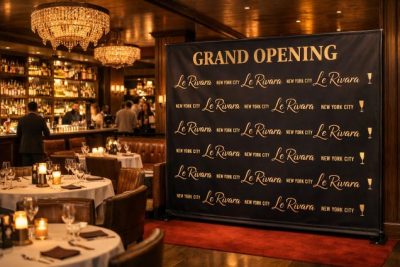
 Roughly 60 percent of restaurants in the United States close within their first year of operation, and New York City’s competitive dining scene makes that figure feel conservative. With thousands of new concepts vying for attention in the five boroughs every year, operators are under enormous pressure to make their launch moment count. One tool that has gained notable traction in recent years is event signage, specifically the branded backdrop banners you see at grand openings, press nights, and influencer events. These installations promise visibility. But do they actually deliver?
The short answer is: sometimes, and only under the right conditions. Resources like step and repeat New York industry guides document how properly designed branded backdrops function during launch events, attracting photo opportunities, encouraging social media sharing, and creating a visual identity that travels beyond the physical venue. The logic is straightforward. A backdrop with a restaurant’s logo, colors, and name becomes the default photo background for everyone attending the opening night. Each image shared online becomes a piece of organic promotion. In a city saturated with dining options, that reach matters.
The Case for Event Branding at Restaurant Launches
There is genuine evidence that visual branding during launch events influences early exposure. Cornell University’s Center for Hospitality Research has long documented how first impressions shape consumer perception in food and beverage settings, noting that the visual environment, including signage, decor, and branded materials, significantly affects how guests perceive quality before they ever taste a dish. A polished, cohesive visual identity signals professionalism and intention.
From a marketing mechanics standpoint, the numbers support the investment. Sprout Social data indicates that posts featuring branded visuals generate significantly higher engagement rates than unbranded content across Instagram and TikTok, the two platforms most heavily used by food consumers discovering new restaurants. When guests at a grand opening post photos in front of a branded backdrop, they are effectively doing promotional work on behalf of the establishment, and those posts reach networks the restaurant itself may not have access to yet.
Media coverage is another legitimate benefit. The James Beard Foundation and food journalists from outlets like Eater NY and The New York Times dining section frequently attend launch events for notable openings. A visually compelling event, one where the branding is consistent, legible, and photogenic, is more likely to generate coverage than one that feels thrown together. Editorial photographers need usable backdrops. A well-produced branded installation solves that problem immediately.
For operators launching in competitive neighborhoods like the West Village, Williamsburg, or Midtown, a strong visual launch moment can create enough initial buzz to fill reservations for the first several weeks. That early momentum, even if partially manufactured through event design, can be enough to seed genuine word-of-mouth. Positive early reviews, full tables, and a sense of cultural moment tend to reinforce each other.
The Limits of a Branded Backdrop
Here is where the argument gets more complicated. Event signage generates attention. It does not generate loyalty. And in New York City’s dining market, the gap between those two things is where most restaurants actually fail.
The National Restaurant Association consistently reports that the top drivers of repeat visits are food quality, service consistency, and value perception, in that order. Signage does not appear anywhere in that list. A grand opening with a stunning branded backdrop and 500 Instagram posts will not recover a restaurant that serves mediocre food or trains its staff poorly. It may, in fact, accelerate failure by drawing large crowds before the kitchen and front-of-house team are prepared to perform at scale.
There is also the question of location, which remains one of the most consequential variables in restaurant survival. Columbia Business School research on urban retail clustering suggests that foot traffic patterns in New York are deeply entrenched. Certain blocks simply convert pedestrians into diners at higher rates than others, regardless of how aggressively a concept markets itself at launch. A beautifully branded backdrop cannot move a restaurant to a better corner.
Social media traction during a launch event is also notoriously short-lived. Nielsen consumer research has documented the rapid decay rate of viral content. Most social posts, regardless of how well-received, fade from algorithmic visibility within 48 to 72 hours. For a restaurant to convert that brief exposure window into sustainable patronage, it needs the product and experience to back it up. The signage opens the door. Everything else determines whether people come back.
Operators should also be cautious about misallocating their launch budget toward visual branding at the expense of operational readiness. Soft-opening periods, staff training, kitchen calibration, and early-stage menu refinement are less glamorous than a well-produced event install, but they matter far more to long-term outcomes.
READ ALSO: Creating Instagram-Worthy Backdrops for Food Events: NYC Step and Repeat Printing Service
A Balanced View: One Tool Among Many
The most honest assessment of event branding for restaurant launches is this: it works, but only as part of a complete strategy.
A grand opening banner or branded backdrop installation is a legitimate mechanism for generating early exposure, creating social media content, and presenting a polished public image. New York’s media ecosystem responds to visual storytelling, and a well-executed launch event does create real opportunities. Operators who dismiss event branding entirely may be leaving earned media on the table during the window when attention is easiest to capture.
At the same time, treating signage as a substitute for substance is a category error that many first-time restaurant owners make. The New York dining market is among the most discerning in the world. Guests who attend an opening night drawn by a well-branded event will form their actual opinions based on what ends up on their plate, how they were treated at the door, and whether the experience felt worth the price. Those judgments determine whether they return, and whether they tell others to go.
Event branding, including the kind of polished backdrop installations that have become common at high-profile restaurant launches, earns its place in a launch strategy when it is proportional, well-timed, and supported by operational excellence. It should amplify a strong restaurant concept, not attempt to compensate for a weak one. Used thoughtfully, it is a useful tool. Relied upon exclusively, it is an expensive distraction.
For operators preparing to open in New York, the question is not whether event signage is worth doing. The question is whether everything behind it is worth photographing.